Research interests: emotions; language; narrative; time; legal studies; critical theory; literary criticism; political thought and legal practice in Latin America
I.
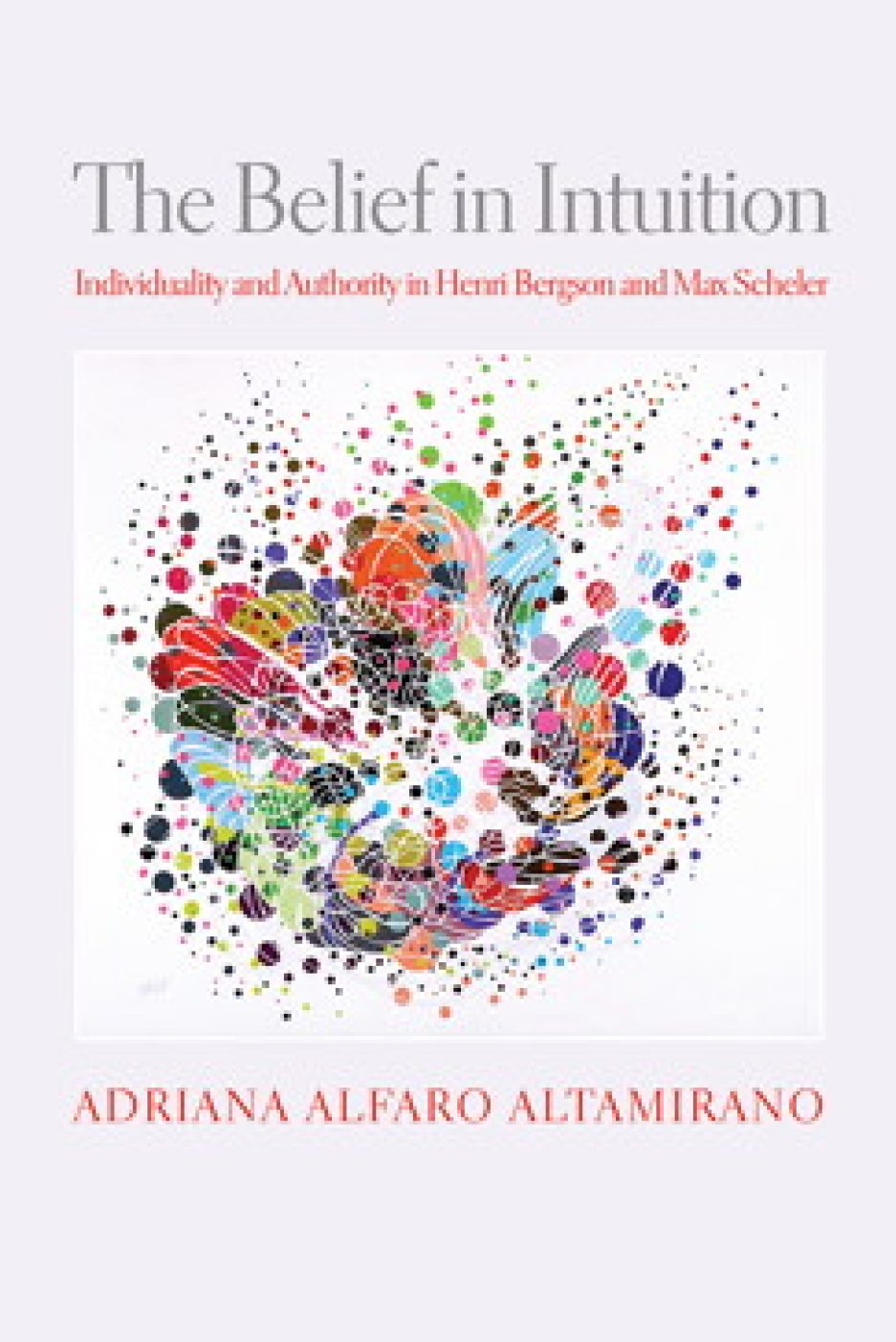
The Belief in Intuition: Individuality and Authority in Henri Bergson and Max Scheler (Philadelphia: University of Pennsylvania Press, 2021).
Reviews and Symposia: Perspectives on Politics, Review of Metaphysics, History of European Ideas, Contemporary Political Theory, and Política y Gobierno
My book looks into Bergson and Scheler—two extremely illustrious figures in their own time but relatively forgotten after WWII—to show that 20th century liberalism and its standard approach to freedom and authority via law and institutions pays a high price for putting aside the phenomenological depths involved in those two concepts. Instead, Bergson’s anti-essentialist metaphysics and Scheler’s philosophical anthropology teach us that a more robust moral psychology—one informed by our temporal nature and capable of acknowledging that human beings cannot be reduced to either reason or sensation, principles or interests—is needed to more fully understand what threatens freedom and corrupts authority.
In parallelly rehabilitating Bergson and Scheler for contemporary audiences in political theory, the book seeks to help us appreciate the current crisis of liberalism and the challenges of populism from a vantage point other than the totalitarian experiences of the previous century, which decisively mark the character of contemporary liberalism. In doing so, it hopes to offer a healthy political corrective for our time.
The following articles (and a translation) are related to my book project:
Max Scheler and Charles Taylor on Self-Knowledge: Dispatches from “the Swarm” (in Legacies of Max Scheler, ed. Eric Mohr and J. Edward Hackett, Marquette University Press, 2025).
The cultivation of the ear: practices of political listening and The Belief in Intuition, Contemporary Political Theory 23 (2024), 640–659 (with Eric Mohr, Simon Glezos, and Mark Westmoreland).
Review exchange of Humberto Beck’s The Moment of Rupture: Historical Consciousness in Interwar German Thought, and The Belief in Intuition, Política y Gobierno 31, no. 2 (2024, in Spanish).
The relation between the ‘City’ and the ‘Soul’, and the role of small-scale exemplars within the city: a response to the symposium on The Belief in Intuition, History of European Ideas 50, 8 (2024): 1491–94.
Max Scheler and Adam Smith on Sympathy, The Review of Politics, Vol. 79, No. 3, Summer 2017, pp. 365-387.
Henri Bergson and the Morality of Uncertainty, Journal of French and Francophone Philosophy / Revue de la Philosophie Française et de la Langue Française, Vol. 24, No. 2, 2016.
Translation of Henri Bergson, Historia de la idea del tiempo. Curso en el Collège de France 1902-1903 (Ciudad de México: Paidós, 2017) (Histoire de l’idée de temps. Cours au Collège de France 1902-1903, PUF). (With Luz Noguez). Free extract from publisher. Reviews: Estudios Filosóficos, Síntesis, Revista Ciencias y Humanidades, El País.
II.
My second project examines different ways in which adjudication (especially in criminal law) fosters structural oppression in present societies—namely, by participating in epistemically unjust practices; by misrepresenting or hampering the agency of defendants and offenders; and by indulging in factious behavior. More concretely, the project does three things: a) examines how language shapes our conceptions of responsibility and moral agency in adjudication in ways that are detrimental to justice; b) explores the relation between impartiality and empathy in judicial decision-making, upholding a more capacious understanding of both; and c) endorses a theory of adjudication that understands judgment not only as the moment of veridiction but also as an instance of story-listening, arguing that the current resistance against so-called judicial backsliding pushes in the opposite direction. Thus, the project is meant to contribute to a reflection—both philosophical and practical—about legal doctrine and judicial ethos, at a time when the appropriate place and function of the judiciary in democratic societies is being vigorously debated.
The Categories of Criminal Law: Cognitive Injustice and Non-sovereign Agency in the Civil Law Tradition, Journal of Social Philosophy (with Adriana Ortega Ortiz; online first 2024)
Maksymilian Del Mar’s Artefacts of Legal Inquiry: Some Reflections, Netherlands Journal of Legal Philosophy 51, no. 2 (2022): 179–86.
Metaphors Judges Live By: “Dirty Minds” and the “Fear of Contamination” in the New Criminal Justice System in Mexico, International Journal of Law in Context, Vol. 17, Issue 4 , December 2021 , pp. 512 – 528.
The Varieties of Judicial Empathy: Impartiality, Self-knowledge, and the Affective Economies of the Courtroom (under review)
Exemplarity and Honor in Times of Judicial Backsliding: Or, How to Sharpen The Ear of Jurisdiction (under review)
Listening to Temptation: What Retributivism Can Learn from the Future (under review, as part of the symposium ‘Listening in the Public Shpere,’ which I am co-editing with Sonali Chakravarti)
III.
A third research track, grounded as well in my interest in language and emotions, focuses thematically on the role of narrative in political theory and in the public sphere. This line of research is rooted in two main ideas. First, narrative speaks to our fundamentally temporal nature and, therefore, it is an important corrective to overly abstract or reductionist approaches to human nature. Second, through narrative it is possible to bridge the artificial gap between reasons and emotions that dominates many areas of our contemporary public sphere and their unduly fears of passion and persuasion.
Narrative and the “Art of Listening”: Ricoeur, Arendt, and the Political Dangers of Storytelling, Political Theory, Vol. 51, No. 2, 2023, pp. 413-435. *Awarded the Wilson Carey McWilliams Prize for Best Paper of the Politics, Literature, and the Arts Section, American Political Science Association, 2022.
Utopias and metaphors for contemporary socialism, Política y Gobierno, Vol. XXVIII, no. 1 (2021): 7-13 (In Spanish)
Political Theory Wishes to Have a Formal Existence (forthcoming at Contemporary Political Theory, as part of the Critical Exchange ‘Political Theory and Storytelling,’ edited by Matthew Longo)
Cute-washing in the Digital World: Samanta Schweblin’s Little Eyes as Critical Dystopia (under review, as part of the Special Section ‘Theorizing Digital Upheavals in the Global South,’ which I am co-editing with Juan Espíndola)
 Adriana Alfaro Altamirano